
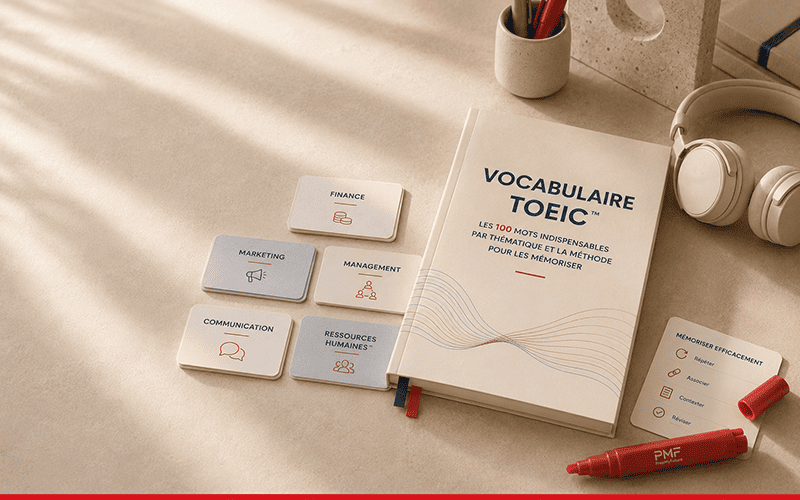
Passing the TOEIC test (Test of English for International Communication) takes preparation. Whether you're aiming for a promotion, a new job, or a qualification, achieving an excellent TOEIC score has become essential. This English test doesn't measure your knowledge of literary English, but your English skills in a professional context and in the business world.
To help with your training, we've gathered essential vocabulary and themed vocabulary sheets here, based on official materials. L'objectif? To help you learn practical English for work and shine in the exam.
I. Work and business vocabulary
In the business world, every term matters. Whether you're talking about contracts or logistics, professional English vocabulary must be precise and impactful.
Contracts and employment (Employment)
Understanding your fixed-term contract (CDD) or permanent contract (CDI) is a fundamental part of English vocabulary.
- Permanent contract (CDI): a permanent employment contract.
- Fixed-term contract (CDD): a fixed-term employment contract.
- Promotion: a promotion or career advancement.
- Quit / To resign: to voluntarily leave one's job.
- Deadline: the crucial milestone in any business project.
Production, logistics, and services
If your TOEIC test focuses on industry or management, expect to encounter these key vocabulary areas:
- Assembly line: the heart of the factory and production.
- Raw materials: the basic resources needed for manufacturing.
- Warehouse: a storage facility.
- Workshop: a manufacturing or repair workshop.
- Subcontracting: subcontracting.
- Procurement: purchasing and supply.
- Health and safety: health and safety at work.
II. Customer service, trade, and financial transactions
Business English vocabulary often includes the management of transactional documents. Confusing a receipt, an invoice, or a discount voucher can affect your understanding during online or paper-based exercises.
- Invoice: the document requesting payment.
- Receipt: proof that payment has been made (receipt, invoice).
- Discount voucher: to get a price reduction.
- Redeem a voucher / use a discount coupon: the act of using a discount voucher.
- Sample: a product sample.
- Invoicing / Billing: the overall process handled by the accounting department.
- Value for money: excellent value for money.
- Target customer: the core marketing audience.
- Upmarket: a high-end product.
- USP (Unique Selling Proposition): the key selling point.
- Word-of-mouth: word of mouth.
- Warranty / Guarantee: a product's warranty.
III. Verbs and Sentence Structure: The Engine of Your Sentences
TOEIC vocabulary is inseparable from grammar. In our study guides, we emphasize the importance of the structure following the verb: some take “To,” others the “-ing” form.
Verbs of Will and Action (Followed by “TO”)
Afford (Afford), Agree (Agree), Aim (Aim), Appear / Seem (Seem), Arrange / Plan (Organize), Ask (Ask), Attempt (Try), Beg (Beg), Choose (Choose), Condescend (Deign), Consent (Consent), Continue (Continue), Dare (Dare), Decide (Decide), Deserve (Deserve), Expect (S'expect), Fail (Fail), Forget (Forget), Happen (Happen to), Have to (Have to), Hesitate (Hesitate), Hope (Hope), Hurry (Hurry), Intend (Intend), Know how (Know how), Learn (Learn), Long (Long for), Manage (Succeed in), Neglect (Neglect), Offer (Offer), Prepare (Prepare), Promise (Promise), Refuse (Refuse), Remember (Remember to do), Strive (Do your best), Swear (Swear), Threaten (Threaten), Want / Would like (Want).
Verbs of State and Feeling (Followed by “-ING”)
Admit (Admit), Anticipate (Anticipate), Appreciate (Appreciate), Avoid (Avoid), Can't help (Can't help), Consider (Consider), Delay / Postpone (Delay / Postpone), Deny (Deny), Discuss (Discuss), Enjoy (Enjoy), Escape (Avoid), Finish / Stop (Finish), Imagine (Imagine), Justify (Justify), Keep (Continue to), Mind (Mind), Miss (Miss), Practice (S'train), Quit (Stop), Recall / Remember (Remember a past action), Resent (Dislike), Resist (Resist), Resume (Resume), Risk (Risk), Spend time (Spend time), Suggest (Suggest).
IV. Succeeding in the Listening Section: Space and Transportation
In the TOEIC tests, the first part is based on photographs. Spatial vocabulary is your best ally.
Prepositions and Positions
- Against: against (e.g., leaning against a wall).
- Alongside / Beside: next to / alongside.
- Opposite: opposite / facing.
- Overhead: overhead.
- Astride: astride.
- Below / Under / Beneath: below / under.
- Beyond: beyond.
- Through / Across: through / across.
Business Travel and Transportation
- Pedestrian: pedestrian
- Rush hour: rush hour.
- One-way street: one-way street.
- Platform: the train platform.
- Carriage: the train car / the car.
- Parking lot: the parking lot.
- Sign: the sign / Lthe sign.
V. Common pitfalls: uncountable nouns and irregular verbs
To optimize your TOEIC preparation, you need to spot the pitfalls that English teachers often point out in class.
Uncountable nouns (No plural form)
These words never take an “s”: Information, Advice, Equipment, Furniture, Luggage / Baggage, Software, Accommodation, Research.
Watch out for irregular verbs
The list of irregular verbs is essential. Learn these key ones: Become, Come, Find, Get, Give, Go, Know, Say, See, Think.
VI. The PrepMyFuture Method: how to remember vocabulary?
Having an English vocabulary list is a good start, but without a method, these terms fade away. Here's our strategy.
Learning from context
Don't get stuck on an unfamiliar word. Use the context to determine how certain you can be about a word's meaning. If you see “budget,” “suppliers,” and “buy,” the word “purchasing” must be related to buying. Also look at the suffixes: “-ment” often signals a noun, while “-ly” signals an adverb.
Looking ahead (Photo section)
For professional English vocabulary related to position, scan each image while asking yourself 5 questions:
- Who? (How many people?)
- What? (What objects? Equipment, furniture?)
- Where? (What place? Warehouse, workshop?)
- Action? (What are they doing? Working, parking?)
- Position? (Where are they? Against the wall, opposite the desk?)
Listening carefully (Homophones)
The TOEIC loves to trick you with similar-sounding words. Learn to distinguish “walking” from “working,” or “hair” from “air conditioner.” Say them out loud to engage your muscle memory.
Learning in chunks (“Chunks”)
Never learn “Afford” on its own. Learn “I can't afford to buy this.” By learning the verb with its preposition and an example, you memorize the meaning, grammar, and usage all at once.
The TOEIC English exam is an exciting challenge. By mastering this vocabulary, you are building the foundations for your future career. Use the internet to read the English-language press and practice each exercise in our vocabulary sheets. Serious preparation is the only way to achieve a TOEIC score you can be proud of.
Ready to take action? Discover our TOEIC L&R preparation courses and TOEIC 4-Skills preparation course.