
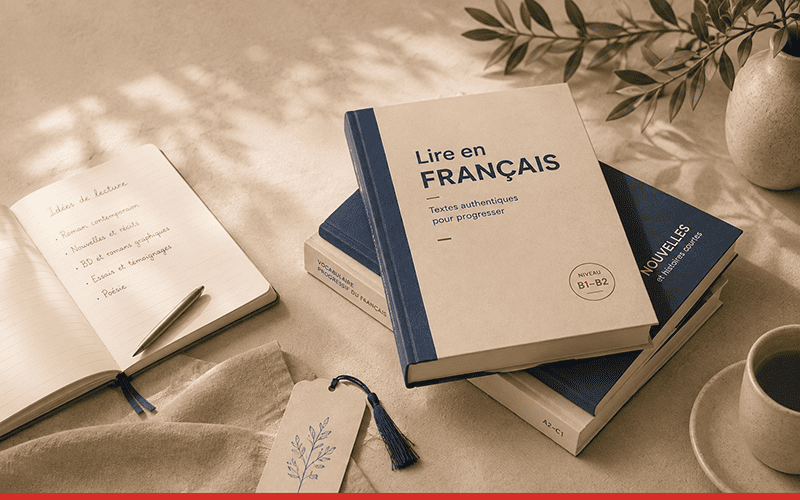
French vocabulary is better maintained through a story than in a list of isolated words. Here is a selection of readings sorted by level, with for each the format, approximate length, and the precise reason why it supports progression at this stage.
Level A2
Les Malheurs de Sophie, Comtesse de Ségur (Youth novel, about 250 pages)
The mischiefs and little domestic troubles of a curious little girl, each serving as a lesson. Everyday vocabulary recurs from one chapter to another, which helps to fix the basics without having to follow a complex plot.
Le Fantôme de l'Opéra, Gaston Leroux (Lire en français facile collection, Hachette FLE, about 64 pages)
A young singer secretly guided by a mysterious phantom haunting the Paris Opera. The original text has been rewritten with deliberately simplified vocabulary and syntax, allowing to follow a complete plot without being hindered by overly complex turns of phrase.
Level B1
Le Petit Prince, Antoine de Saint-Exupéry (tale, about 95 pages)
An aviator stranded in the desert gathers the confidences of a little prince from another planet. The short sentences and deliberately simple vocabulary leave room for reflection on the meaning of the text, rather than just the difficulty of the language.
Le Petit Nicolas, René Goscinny and Jean-Jacques Sempé (short story collection, about 160 pages)
The daily life of a schoolboy and the mischief of his group of friends, told with humor. The familiar expressions from the playground bring it closer to spoken language, while still supported by childlike vocabulary, thus accessible.
Monsieur Ibrahim et les fleurs du Coran, Éric-Emmanuel Schmitt (short novel, about 100 pages)
The friendship between a young Jewish boy from a Parisian neighborhood and the Muslim grocer who becomes his confidant. Its brevity allows completing a full story in a few evenings, a good test before tackling a longer novel.
L'Arabe du futur, Riad Sattouf (autobiographical comic book, about 160 pages)
A childhood shared between Libya, Syria, and France. The comic book format relies on images to clear up much of the vocabulary ambiguities, which lightens the reading effort.
L'Odyssée d'Hakim, Fabien Toulmé (graphic narrative, about 150 pages, complete trilogy)
The journey of a Syrian refugee to Europe. The vocabulary remains common despite the seriousness of the subject, and the images illuminate the text as in The Arab of the Future.
Level B2
Arsène Lupin, gentleman-cambrioleur, Maurice Leblanc (short story collection, about 250 pages)
The adventures of the gentleman burglar, master of disguise, who outwits police and adversaries with flair. The style, more formal and dated from the early 20th century, accustoms to a literary register different from today's spoken language, useful to broaden one’s palette.
Le Tour du monde en quatre-vingts jours, Jules Verne (novel, about 280 pages)
A crazy bet, to complete a trip around the world in eighty days, leads Phileas Fogg in a race against time. The technical and geographical descriptions enrich vocabulary beyond the everyday register.
L'Étranger, Albert Camus (novel, about 185 pages)
The detached existence of an Algerian employee, disrupted by a murder committed almost without reason. The syntax remains simple despite demanding themes, which encourages reading between the lines rather than word for word.
Ensemble, c'est tout, Anna Gavalda (novel, about 570 pages)
Four loners who have nothing in common end up forming a family of the heart by living together in Paris. The dialogues, very close to spoken language, help recognize in writing turns of phrase heard in conversation.
Petit Pays, Gaël Faye (novel, about 220 pages)
A carefree childhood in Burundi disrupted by civil war. The varied vocabulary and historical context broaden the lexicon beyond everyday life, while remaining supported by fluid writing.
Level B2 to C1
La Vérité sur l'affaire Harry Québert, Joël Dicker (novel, about 660 pages)
The young writer Marcus Goldman returns to support Harry Quebert, his former mentor, accused of the thirty-year-old murder of a teenage girl, and uncovers the secrets of a small American town. The alternation between the present investigation and memories from 1975, in short chapters, maintains a brisk pace despite the length of the novel, with investigative vocabulary always put into context by the plot.
La Promesse de l'aube, Romain Gary (autobiographical narrative, about 460 pages)
Romain Gary recounts his childhood between Eastern Europe and Nice alongside his mother, convinced of the exceptional destiny reserved for her son, up to his own career as an aviator in the Free French Forces. The writing, carried by self-mockery and lyrical flights, softens vocabulary otherwise rich and sometimes dated, inherited from the historical context of the 1930s to 1940s.
Astérix (per album), René Goscinny and Albert Uderzo (comic book, about 48 pages per album)
In a small Gaulish village still resisting the Roman invader, a clever warrior and his faithful sidekick chain adventures. The wordplays and cultural references can only be understood with a good mastery of the language and its codes: a natural test of the level reached.
Number of pages given as an indication: it varies depending on the edition.