
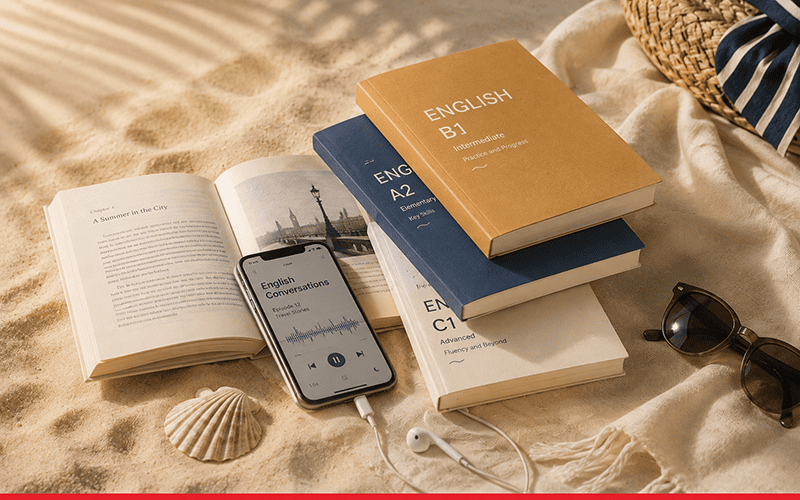
No need for long revision sessions to maintain your English over the summer. Just a few minutes of reading or listening each day is often enough to keep your vocabulary active and learn new expressions in context. To progress without turning your vacation into a classroom, discover our selection of books and podcasts, organized by level and designed to make learning enjoyable.
Accessible readings and listens to get back into English
The Wizard of Oz (L. Frank Baum): a tornado carries Dorothy and her dog Toto to the land of Oz, where she follows the yellow brick road to find a wizard who can bring her home. Simple and rhythmic prose, originally intended for young English-speaking readers.
Animal Farm (George Orwell): on an English farm, the animals drive out their farmer and try to organize themselves, before a group of pigs gradually takes power. A short political fable, written in deliberately simplified English.
The Giver (Lois Lowry): Jonas grows up in a community that has eliminated pain, colors, and free will in the name of harmony, until he is entrusted with the memory of everything others have forgotten. Short and direct sentences, a classic of English-language youth literature.
Short Stories in English (collection of short stories): several independent stories by different authors and styles. The short format allows you to finish a whole text in one session, without having to follow a plot from day to day.
Podcast - How to Be a Better Human (TED): each short episode starts with a small daily behavior change, featuring an expert guest on the topic.
Podcast - On Purpose with Jay Shetty: interviews focused on personal development and the search for meaning, with guests from various backgrounds. Clear and measured English, easier to follow than free conversation.
Stimulating content to keep progressing
The Lost World (Arthur Conan Doyle): Professor Challenger returns from the Amazon claiming to have discovered a plateau where prehistoric creatures have survived, and sets out with an expedition to prove it. A pace driven more by action and dialogue than by complex descriptions.
The Great Gatsby (F. Scott Fitzgerald): Nick Carraway moves near the mansion of Jay Gatsby, a mysterious new rich man who throws lavish parties to win back a youthful love. Polished but accessible language, despite its reputation as a classic.
A Line to Kill (Anthony Horowitz): the author, becoming a character in his own novel, investigates alongside detective Hawthorne a murder committed during a literary festival on a small Anglo-Norman island. A contemporary plot, carried by very natural dialogues.
The Midnight Library (Matt Haig): between life and death, Nora Seed discovers an infinite library where each book lets her try a different life, the one she would have had if she had made other choices. Fluent and modern English.
Podcast Business Wars (Wondery): each season narrates the rivalry between two giants in the same sector (Nike vs. Adidas, Netflix vs. Blockbuster). Economic vocabulary always contextualized by the story.
Podcast Diary of a CEO (Steven Bartlett): long one-on-one interviews with guests from business, health, or psychology. A good listening exercise to get used to a single voice per episode.
More demanding works to enrich your English
The Handmaid's Tale (Margaret Atwood): in a totalitarian society that has abolished women's rights, Offred tells from the inside her life reduced to a single function. Denser prose and more challenging content.
1984 (George Orwell): Winston Smith works for a regime that rewrites history and monitors even the thoughts of its citizens, and secretly begins to doubt. More advanced political and philosophical vocabulary, origin of expressions still used today (Big Brother, Newspeak).
Podcast - High Low with EmRata (Emily Ratajkowski): a weekly conversation on cultural news and society. An oral and spontaneous register, close to everyday spoken English.
Podcast - Anything Goes (Emma Chamberlain): a solo format where the author comments on her week and current thoughts. A very relaxed tone, rich in familiar expressions.
Three tips to progress without turning summer into revision
- Choose a story that makes you want to keep going: vocabulary sticks better in context than on an isolated list.
- Don’t look up every unknown word; once you understand about 80%, keep reading.
- Set a manageable goal: ten minutes a day or one chapter each evening is enough.