
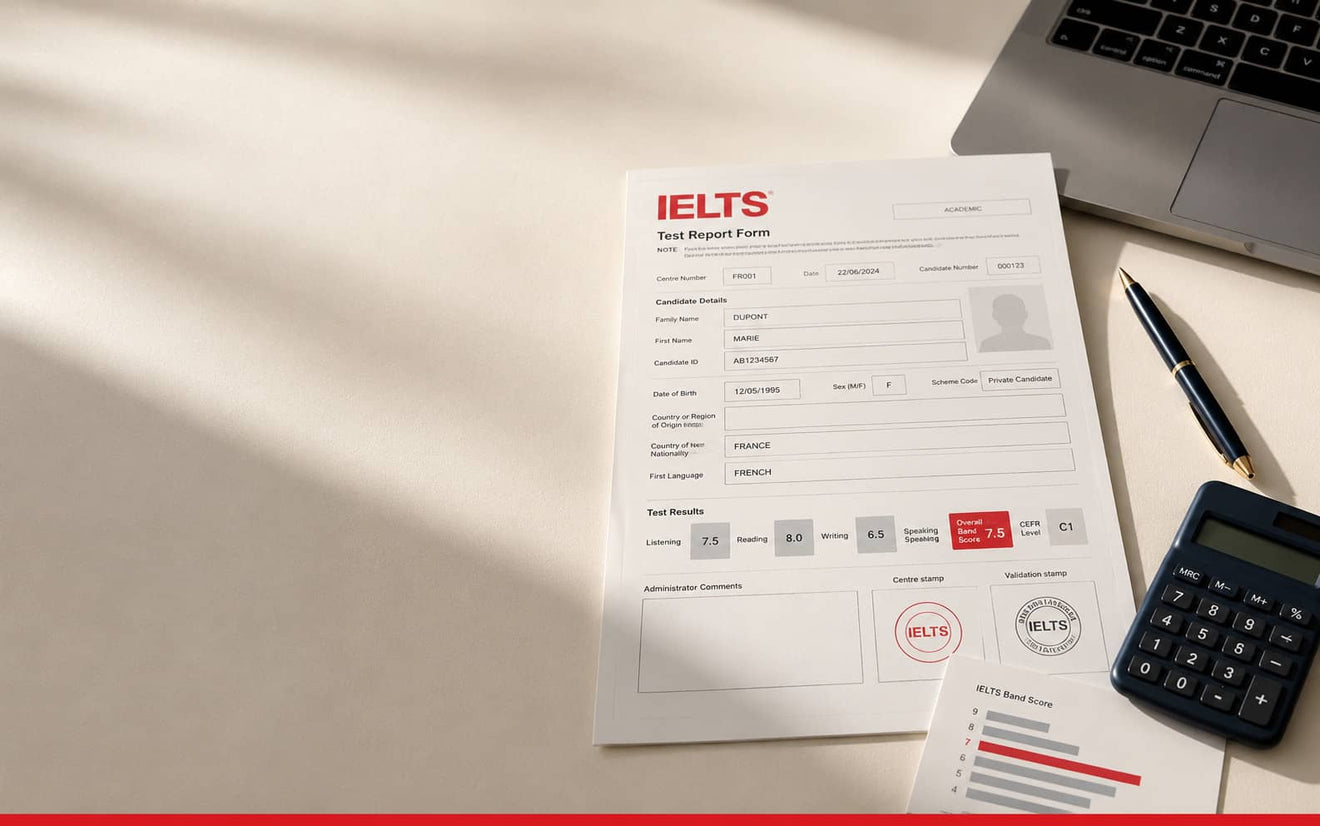
The IELTS overall band score ranges from 1 to 9. This scale indicates your level of English proficiency. Here is what each score means, what score to aim for, and how long your result remains valid.
Understanding your result
- 1: very low level; the person knows only a few English words.
- 2: the candidate has difficulty understanding the language and expressing themselves.
- 3: the candidate can communicate in basic situations but makes many mistakes.
- 4: the candidate can hold a simple conversation but has difficulty discussing specific or complex topics.
- 5: proficiency is incomplete, but the person can manage in a variety of situations.
- 6: the candidate is proficient in English, with only a few vocabulary or grammar mistakes.
- 7: good overall proficiency, with a few awkward usages in unfamiliar situations.
- 8 and 9: very good to expert level.
What score to aim for
To enter a university, you generally need an average score of at least 6, and usually no section score (reading, listening, writing, speaking) should be below 6. Some programs are more selective: law, for example, requires an average of 7 to 7.5. If you have a specific institution in mind, contact it directly to find out its requirements.
So don't settle for a minimum score: aim as high as possible. A good result is necessary for admission, and it also enhances your résumé.
Score validity period
The IELTS test is valid for 2 years. After that, your score is no longer valid, as your level is considered to have changed (Can you retake the IELTS?).