
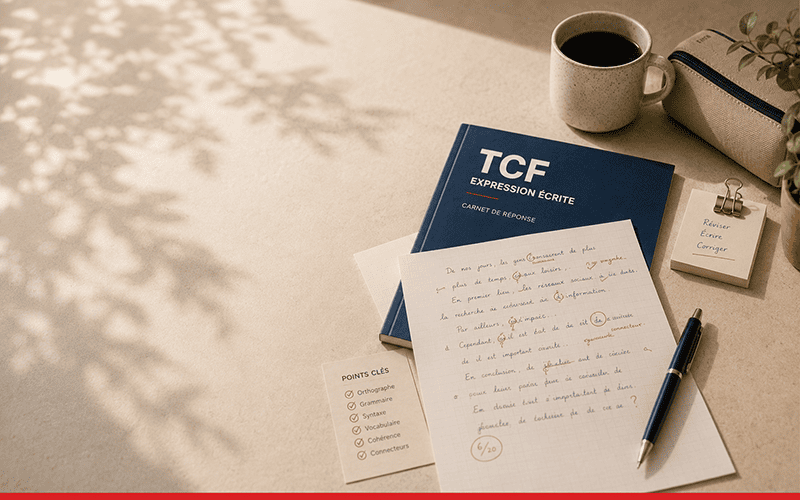
You have reviewed the grammar rules, mastered your vocabulary sheets, and practiced writing. However, on the day of the TCF, certain mistakes can cause you to lose valuable points. Discover the 10 most penalizing errors for TCF candidates and tips to correct them before the big day.
Error No. 1: Not respecting the required word count
Each writing task requires a minimum and maximum length, which varies depending on the exercise and the TCF version. If one of your texts does not meet the required word count, your work may not be graded, which can significantly lower your score. The expected word count is clearly indicated in the instructions. Read them carefully before you start writing.
Tip for practice: write regularly with a set limit. Then count your words to learn how to quickly estimate the length of your text.
Error No. 2: Not completing the tasks in order
In the writing test, you must start with task 1, then complete tasks 2 and 3. If you do not follow this order, you risk spending too much time on the most complex task and not finishing the test. An unfinished task can also cause you to lose points, regardless of the quality of your other texts.
Tip for practice: during your training, complete the three tasks in sequence under exam conditions. Set a maximum time for each task.
Error No. 3: Writing off-topic
Reading the instructions too quickly can lead you to write an off-topic response. The instructions always specify the expected format (describe a person, tell an event, etc.) and the information to include. For example, if you must present a person by indicating their age or character, a simple physical description is not enough and could be considered off-topic.
Tip for practice: read the instructions and underline each required element. After writing, check that all the underlined points appear in your text.
Error No. 4: Not adapting to the communication situation
The conventions for writing a message, a forum post, or a blog article are not the same. For example, a message includes a greeting and a closing formula. Also, the choice of salutations depends on the recipient (friend, colleague, etc.). Not respecting the requested format can show that you did not adapt to the communication situation.
Tip for practice: before each writing, identify the type of text requested, the recipient (if any), and the appropriate formulas.
Error No. 5: Writing a text without structure
Even if your sentences are correct, writing a text without clear progression can cause you to lose points. To express your opinion, start by briefly presenting the topic. Then develop your point of view with arguments, and finish with a short concluding sentence. This three-part organization will help you structure your texts and make them more understandable.
Tip for practice: before writing, spend a minute creating a simple outline with the order of your ideas and some keywords.
Error No. 6: Linking ideas without logical connectors
Logical connectors indicate the relationship between your ideas. They allow you to add information, explain a cause, express opposition, or conclude. Without them, the text can seem like a series of independent sentences. Use connectors such as “first,” “then,” and “finally” to narrate, or “indeed,” “however,” and “that’s why” to argue.
Tip for practice: practice writing a short text, then add linking words when the relationship between two ideas is not clear enough.
Error No. 7: Using repetitive or limited vocabulary
Using the same verbs and adjectives can limit the precision of your texts. If you often use vague words like “good,” “thing,” or “do,” try to replace them with more precise terms. Also, the vocabulary used should match the requested topic. If the instructions ask you to describe a birthday event, make sure to use vocabulary appropriate to the situation described (party, guests, gifts, cake, candle, etc.).
Tip for practice: create vocabulary sheets by theme, then write a short text using five words or expressions from the sheet.
Error No. 8: Not using the correct verb tenses
If the verb tenses in your text are not used consistently, your message can become confusing. Remember that the present tense is suitable for describing a current situation or explaining a habit. To tell about a past, completed, and time-limited action, use the passé composé. To describe a situation or habits in the past, the imperfect tense is more appropriate.
Tip for practice: write a short text, then underline the verbs. Check that each tense matches what you want to express.
Error No. 9: Giving your opinion without justifying it
Writing “I agree” is not enough in an argumentative task. You must explain your point of view with one or more reasons. You can then illustrate your argument with a concrete example. This approach shows examiners that you know how to argue and build coherent reasoning.
Tip for practice: after each opinion given, make yourself add a sentence starting with “because,” “since,” or “indeed,” then an example when possible.
Error No. 10: Submitting your work without taking time to proofread
By allowing yourself a few minutes to proofread, you can easily correct simple errors. Check agreements, verb endings, repetitions, and punctuation. Also reread the instructions to ensure you have answered all the requirements. Do not try to completely rewrite your text at the last minute to avoid adding new mistakes.
Tip for practice: always use the same proofreading checklist. For example, first check compliance with the instructions, then structure, verbs, agreements, and finally, spelling.