
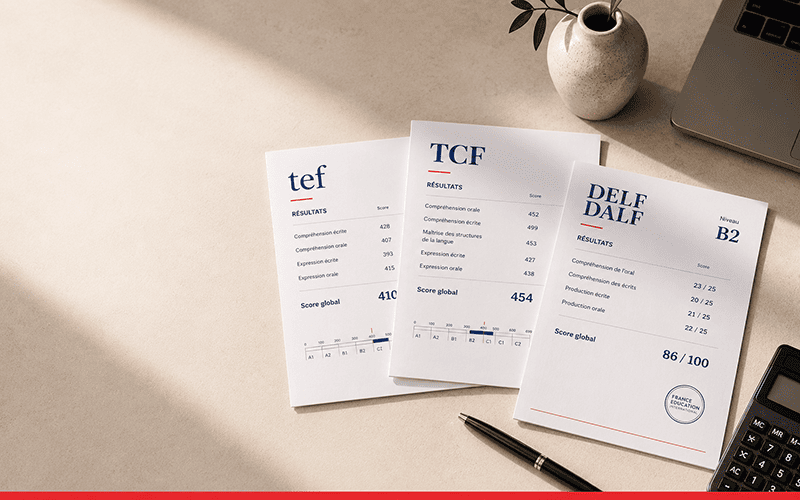
The scoring systems for these tests differ somewhat and are worth examining more closely to understand how the overall score for these certifications is determined.
DELF / DALF
The DELF certifies a minimum level of French proficiency: it is a pass mark. If candidates achieve this score, they pass the exam. The DELF and DALF are assessed using the same scoring system: each test is scored out of 25 points, for a total exam score of 100. To pass, candidates must score at least 5/25 in each test and at least 50 points overall. DELF-DALF levels follow the Common European Framework of Reference for Languages (CEFR), which defines 6 proficiency levels: A1, A2, B1, B2, C1, C2.
TCF
Each compulsory TCF test is scored out of 699 points (learn more about TCF practice). The total score is the average of these tests, also out of 699. You then simply refer to the CEFR scale to find the corresponding level.

If you also take the optional speaking and writing tests (often as part of the TCF Canada), refer to the following table for your score and the corresponding CEFR and NCLC levels:

TEF
The TEF is also scored out of 699. The principle is the same as for the TCF, except that all tests, without exception, are scored out of 699. The score obtained is converted into CEFR levels and, where applicable, NCLC levels for candidates immigrating to Canada. The table below shows the level achieved (CEFR and NCLC) for each TEF test, and also applies to the overall score:

TEF tip: Since April 15, 2021, if your goal is French naturalization, you achieve level B1 when your score is at least 300 in at least 3 of the tests taken, and at least 267 in each test.
TEF Preparation | TCF Preparation | DELF Preparation