
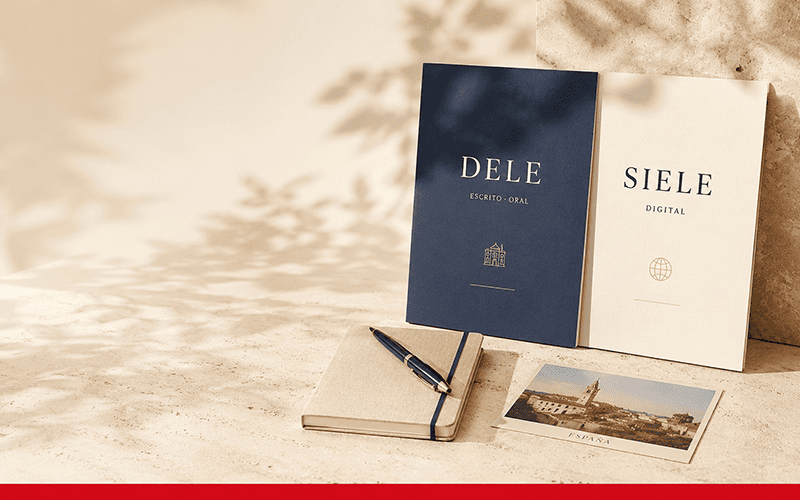
The DELE
The DELE (Diploma of Spanish as a Foreign Language) is an official certification issued by the Instituto Cervantes, on behalf of the Spanish Ministry of Education. It certifies a specific language level, which the candidate chooses in advance, according to the CEFR scale (from A1 to C2). The diploma is valid for life.
The exam takes place in person, on fixed dates, at authorized centers. It is internationally recognized for administrative procedures, admission to Spanish universities, or obtaining Spanish nationality.
The SIELE
The SIELE (International Spanish Language Evaluation Service) is a more recent test (2016), developed by the Instituto Cervantes in collaboration with the National Autonomous University of Mexico, the University of Salamanca, and the University of Buenos Aires.
Unlike the DELE, the SIELE is a fully digital multi-level exam. The candidate does not choose a level in advance: they receive a score and a corresponding level on the CEFR scale (A1 to C1). The SIELE is valid for 5 years.
Main Differences
The following table summarizes the main differences between the DELE and the SIELE:
- Format: the DELE is paper-based and in person; the SIELE is entirely online.
- Level: the DELE assesses a level chosen in advance (A1 to C2); the SIELE automatically determines the candidate’s level (A1 to C1).
- Validity: the DELE is valid for life; the SIELE is valid for 5 years.
- Date flexibility: the DELE takes place on fixed dates; the SIELE can be taken anytime, at an authorized center or remotely.
- Modular format: the SIELE allows taking separate modules (S1 to S5); the DELE is organized by complete level.