
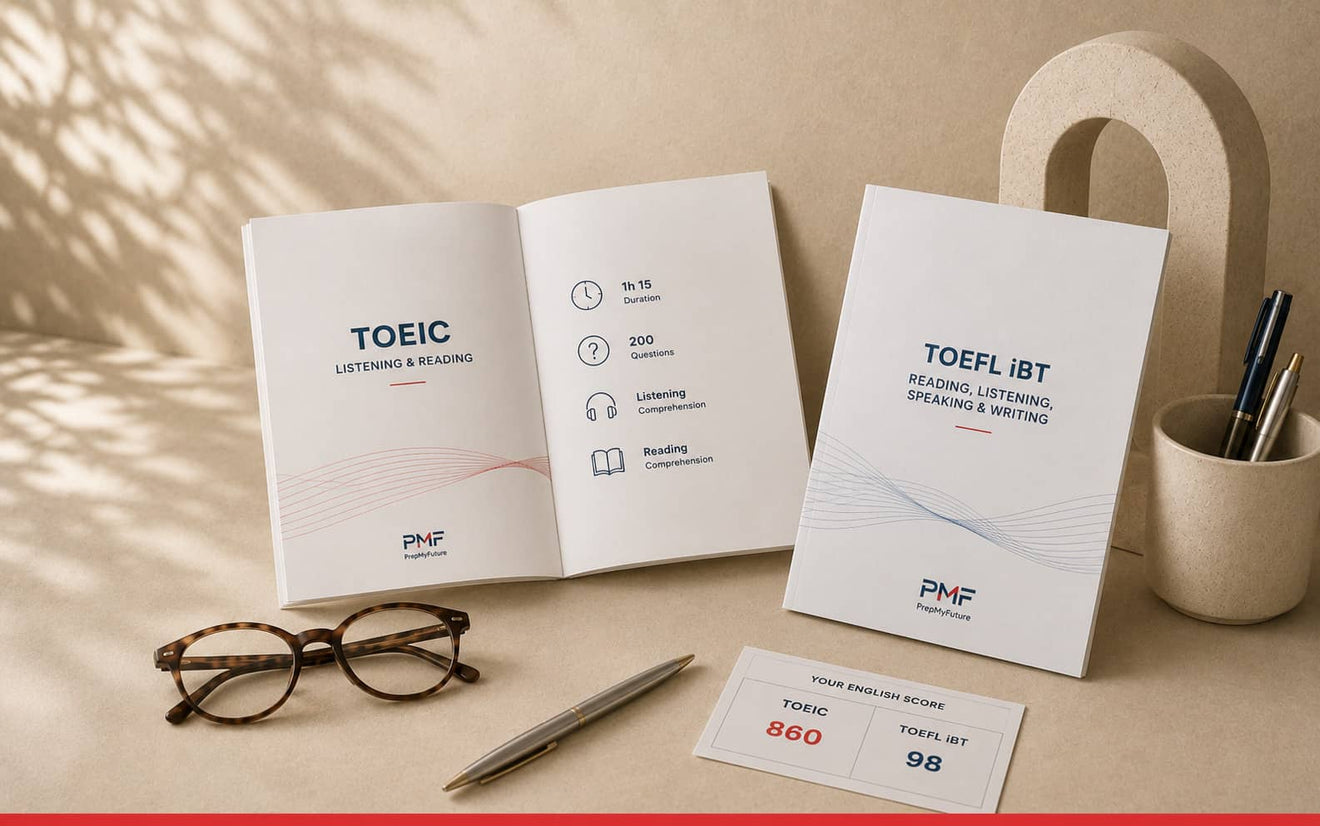
What are the differences between the TOEIC and the TOEFL?
The TOEIC and TOEFL measure two different skills. The TOEIC measures your ability to work in English, while the TOEFL measures your ability to take university courses in English. Both tests are developed and administered by ETS (Educational Testing Service).
Different goals
The TOEIC is a test designed for the job market. It can enhance your résumé by demonstrating your English proficiency in a business context. Recruiters take TOEIC scores into account. If you need a certification for your résumé, we recommend the TOEIC if you work in France, Japan, or South Korea, the three countries where the TOEIC is most widely used.
The TOEFL, on the other hand, is intended for students who wish to study abroad as part of a university exchange program. All universities in English-speaking countries require a minimum TOEFL score. In most cases, you need to take the TOEFL iBT to get a score ranging from 70 for less prestigious universities up to 100/120 for the most prestigious ones.
Format and scoring
The TOEIC Listening & Reading tests only listening and reading comprehension through multiple-choice questions. It is scored out of 990. The TOEFL iBT tests all four core skills (reading and listening comprehension, and written and spoken expression). It is scored out of 120. The results of both tests can be converted to the CEFR scale: from level A1 to C1 for the TOEIC, and from level B1 to C2 for the TOEFL.