
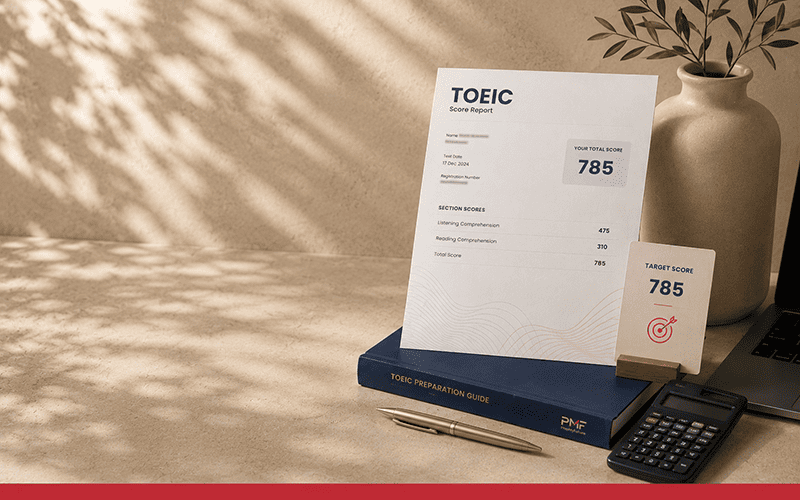
There is no single passing score for the TOEIC: you don't "pass" or "fail" it; you get a score that reflects your level. The real question is: what score should you aim for, depending on your goal? An engineering degree, business school, a job, international mobility... each goal has its own threshold. Here's how to interpret your score and what target to aim for.
How is the TOEIC score calculated?
The TOEIC Listening & Reading, the most widely used version, is scored from 10 to 990 points. It consists of two sections, each scored from 5 to 495 points:
- listening comprehension (Listening);
- reading comprehension (Reading).
Your final score is the sum of the two sections. Important: the TOEIC L&R assesses comprehension only, not expression. To have your speaking and writing assessed, there is a separate test, the TOEIC Speaking & Writing. Finally, your score is valid for 2 years: after that, you will need to retake the test to prove your level.
What score should you aim for, depending on your goal?
Earn an engineering degree
The Commission des Titres d'Ingénieur (CTI) requires a minimum score of 785 points (CEFR level B2) to award an engineering degree in France. This is the most widely required threshold in the country. Without it, graduation may be delayed, so it is best to plan ahead well before the end of your studies.
Get into or graduate from a business school
Business schools most often require this same threshold of 785 points to award the degree, and some set the bar higher, between 850 and 900 points, particularly for the most selective or internationally focused programs.
Boost your CV and find a job in France
In the French job market, it is advisable to list your TOEIC score on your CV if it is at least 750 points. Between 750 and 850, it signals a good level of professional English and reassures recruiters. Below 600 to 650 points, it is often best not to mention it on your CV.
Working internationally or moving abroad
For a highly international role, an overseas posting, or a VIE, aim for 850 to 900 points or higher. A score above 900 is a strong asset on a résumé and demonstrates genuine proficiency in English.
TOEIC score and CEFR level conversion
To place your score on the European reference scale (the CEFR), here is the TOEIC Listening & Reading score conversion chart:
| CEFR level | TOEIC L&R score | What this means |
|---|---|---|
| A1 | 120 – 224 | Beginner level |
| A2 | 225 – 549 | Basic user |
| B1 | 550 – 784 | Limited independent user |
| B2 | 785 – 944 | Advanced independent user, proficient |
| C1 | 945 – 990 | Near mastery |
This chart helps you interpret your score in terms of a proficiency level and set a realistic goal based on your starting point.
So, what score should you aim for?
In short: 785 (B2) is the key threshold for earning an engineering or business degree; 750 or higher enhances your résumé in France; 900 or higher opens doors internationally. The best approach is to set a specific target from the start of your preparation: this gives structure to your revision and lets you track your progress with each practice test.
Frequently asked questions
Does the TOEIC have a failing score?
No. There is no failing score and no negative marking: you always receive a score between 10 and 990. So answer every question, even if you're unsure.
What is the maximum TOEIC score?
The maximum score is 990 points, with 495 in Listening and 495 in Reading.
Can you retake the TOEIC to improve your score?
Yes, you can retake it as many times as necessary to achieve your target score (can you retake the TOEIC several times?).
How can you achieve your target score?
The TOEIC tests not only your level of English but also your test-taking skills: mastering the format, managing your time, and knowing the question types can earn you valuable points. To target your goal effectively, explore PrepMyFuture's TOEIC preparation: course materials, exercises with answer keys, and practice tests under real exam conditions to help you improve section by section.